
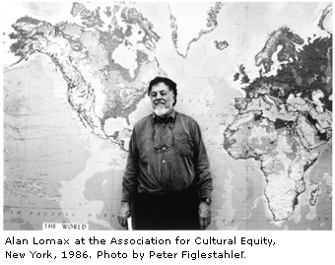
The Association for Cultural Equity (ACE) was founded by Alan Lomax to explore and sustain the world's expressive traditions with humanistic commitment and scientific engagement. ACE was registered as a charitable organization in the State of New York in 1983, and is housed at New York City's Hunter College.
"It still remains for us to learn how we can put our magnificent mass communications technology at the service of each and every branch of the human family." - Alan Lomax
OUR MISSION
Our mission is to stimulate cultural equity through preservation, research, and dissemination of the world's traditional music and dance, and to reconnect people and communities with their creative heritage. ACE is a living archive that puts its collections and works at the service of communities of origin, endangered cultures, emerging cultural leaders, students and teachers at all levels, and the scientific community.
BACKGROUND
Alan Lomax was a musicologist, writer and producer who spent his life researching and promoting unrecorded and unrecognized music, dance, and oral traditions. In order to reaffirm the beauty and unique value of folk traditions to their source communities and on the world stage, he developed a feedback approach to research, archiving, and dissemination. A tireless advocate, Lomax attempted to influence government policy on arts and culture at every level and addressed a white paper on national cultural policy to the National Endowment for the Humanities, stressing the need to support local, regional, and immigrant folklife. In 1972 UNESCO published his influential “Appeal for Cultural Equity” arguing the right of every culture to safeguard, express, and develop its artistic and expressive heritage.
After Lomax's retirement in 1996, his daughter, Anna Lomax Wood, undertook the preservation and dissemination of his legacy at the Association for Cultural Equity. The American Folklife Center of the Library of Congress and ACE forged a unique partnership, by which the Library acquired Lomax's original collections, and ACE put them into wide circulation.
WHAT WE DO
ACE is custodian of the Alan Lomax Archive, a priceless collection of recorded music, dance, and the spoken word. Our mission is to facilitate cultural equity through preservation, publication, and repatriation of our materials. We practice cultural feedback by freely distributing thousands of recordings, photos and videos through our website and various social networking outlets, and in partnership with institutional and educational partners. Through our own record label and in collaboration with other labels and cultural institutions we maintain an active publishing arm. ACE repatriates artists' rights and royalties to their estates and families, and returns our media collections to those who created them and their places of origin.
While we strive to make our collections accessible and meaningful to the general population, we reach out to specific regional and ethnic populations through capacity-building projects, both web-based and in on-the-ground partnerships. Regional dissemination and repatriation efforts have included collaborations with cultural centers, libraries, and universities in Alabama, South Carolina, Virginia, Mississippi, Louisiana, and the Schomburg Center for Research in Black Culture in New York City, as well as in Spain, Italy, Scotland, England, and across the Caribbean. We reach teachers and elementary through high school students through our growing roster of lesson plans, and with workshops and demonstrations.
We are currently updating and making Internet-compatible the Global Jukebox, the remarkable multi-media research and educational program spearheaded by Alan Lomax in the early 1990s. This will enable us to share the research paradigms, findings, and data of Lomax's research initiatives with musicologists, movement specialists, evolutionary anthropologists, and other scholars worldwide, as well as with the general public.
ACE's partners and collaborators include The Library of Congress, the Rock Foundation, Green Family Foundation, the Schomburg Center for Research in Black Culture, the Center for Black Music Research, the Grenadian Ministry of Tourism & Culture, Irish Traditional Music Archive, La Médiathèque Caraibe Bettino Lara, the Musée de l'Homme, and the many individual scholars and researchers whose names appear on these pages.
ACE is an UNESCO-accredited non-governmental organization providing advisory services to its 2003 Convention for the Safeguarding of Intangible Cultural Heritage (ICH).
The Association for Cultural Equity is a 501(c)(3) not-for-profit charitable organization chartered in the State of New York.
ACE's Programs are made possible in part by the New York State Council on the Arts with the support of the Office of the Governor and the New York State Legislature.